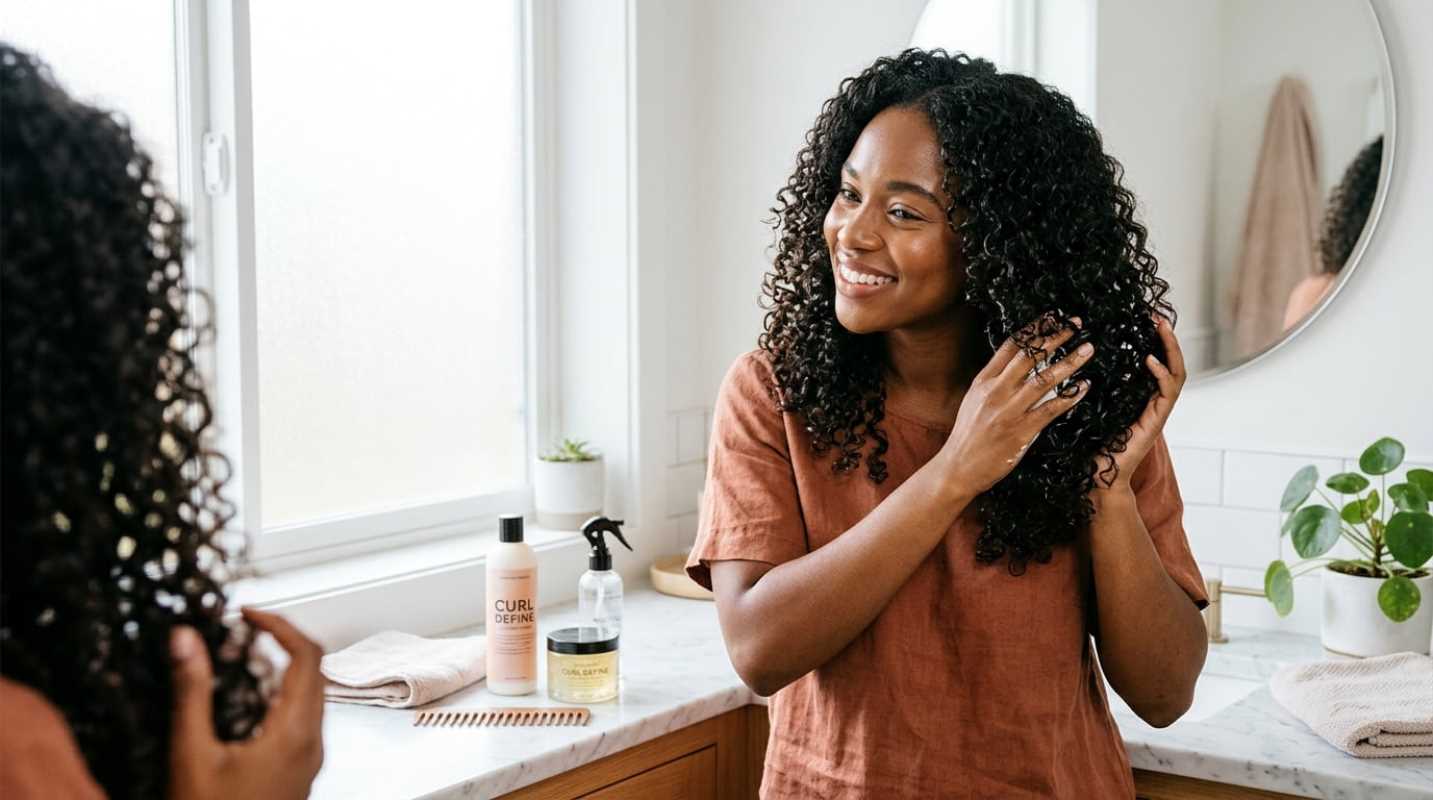
Have you ever stepped outside on a humid morning only to watch your carefully styled hair morph into a puffy halo within minutes? Have you spent years battling your natural texture, wondering why products that look amazing on someone else leave your strands dry or greasy?
You are in good company. Around 60 to 70 percent of people across the globe have wavy, curly, or coily hair.¹ Yet so many of us grew up without learning how natural curls actually function. For decades, traditional beauty standards nudged people toward straighteners and harsh chemical treatments.
Curly hair has an elliptical, curved follicle. That unique shape creates the gorgeous twists and spirals you see, but it also creates physical obstacles. Natural scalp oils cannot easily travel down an uneven, corkscrew-shaped path. Because of that structural detour, curls tend to dry out much faster than straight strands.
Frizz is not a personal failure or a flaw in your hair. It is simply physics. When hair cuticles are raised or dehydrated, they act like tiny sponges searching for water in the surrounding air. When ambient humidity slips past the open cuticle, the internal hydrogen bonds shift and swell. Understanding that moisture and curl definition work together is the first step toward getting soft, predictable results every wash day.
Gentle Washing and Drying Techniques
For years, internet forums insisted you should ditch shampoo completely and rely only on cleansing conditioners. That advice backfired for thousands of people. Trichologists have linked heavy co-washing to product buildup, flaking, and clogged follicles that can lead to seborrheic dermatitis.²
Think of your routine like skincare. You would not rub heavy cold cream on your face daily without ever washing it off. Your scalp is living skin that sheds dead cells and produces oil. It needs thorough, gentle cleansing so your roots can breathe.
Balance is everything. You want to lift dirt, sweat, and styling residue without stripping your natural protective lipid barrier
• Routine cleansing: Wash every three to seven days using a sulfate-free shampoo powered by mild cleansers like cocamidopropyl betaine or decyl glucoside.
• Clarifying resets: Use a chelating or clarifying wash every two to four weeks to remove stubborn mineral deposits from hard water and product film.
• Sectioning: Divide your hair into four or six loose sections in the shower to keep strands from tangling while you massage your scalp.
How you dry your hair is just as important as how you wash it. Regular terry cloth bath towels have tiny loops that grab hair cuticles, rip apart curl clumps, and absorb hydration way too quickly. Put the rough towel away.
Grab a smooth microfiber towel or a plain cotton T-shirt instead. Use a technique called micro-plopping, gently cupping and squeezing your curls upward toward your roots to remove dripping water without disrupting the pattern.
If you prefer using a blow dryer, always attach a diffuser. Try the hover method first. Keep the dryer roughly six inches away on low heat and medium airflow, sweeping around your head without touching your hair until a light protective shell forms. Once that shell sets, scoop sections directly into the diffuser bowl and hold them against your scalp for thirty seconds to build volume.
Locking in Moisture and Definition
Applying your stylers at the right moment makes all the difference. The best time to apply leave-in conditioner and styling gel is when your hair is still soaking wet. Doing this locks water molecules deep inside the cortex before air exposure has a chance to trigger fuzz.
Porosity dictates what your hair needs. Low-porosity curls have tight, flat cuticles that resist hydration. They need lightweight leave-in sprays and light warmth during deep conditioning to open the cuticle. High-porosity curls have gaps and chips along the outer surface from heat or color. They need richer creams, restorative proteins, and sealing oils to plug those microscopic holes.
To build lasting hydration, use the LOC method (Liquid, Oil, Cream) or the LCO method (Liquid, Cream, Oil). Liquids provide hydration, creams smooth the cuticle layer, and light oils seal the surface so water cannot escape.
Once your base hydration is locked in, you need a styler that creates a protective cast. A medium-to-firm hold gel or styling custard contains polymers that link together around your curl clumps as they dry. This firm cast shields your curls from shifting humidity outside.
Leave your hair alone while it dries. Touching wet curls breaks up natural clumps and creates immediate halo frizz. When your hair is 100 percent dry, warm two drops of squalane, argan, or jojoba oil in your hands. Gently scrunch your hair upward to break the crunchy barrier. You will reveal soft, defined curls that hold their shape for days.
Looking for the best curl cleansers, diffusers, and stylers to upgrade your routine? Explore our top-tested picks below.
Strategic Protective Styling for Daily Maintenance
Mechanical friction is a major enemy of smooth curls. Every time your hair rubs against cotton sheets, rough coats, or sweater collars, the cuticle fibers snag and separate.
Nighttime protection keeps your wash-day definition intact and saves you valuable time in the morning
• The pineapple method: Gather your curls loosely at the crown of your head using a soft silk or satin scrunchie, looping it just once so it leaves no crease.
• Silk or satin covers: Switch to a silk pillowcase or wear a satin-lined bonnet to keep fabric from leaching moisture out of your hair while you sleep.
• Gentle daytime braids: Loose two-strand twists or French braids protect fragile ends during blustery days without pulling your roots.
Watch your tension closely. The American Academy of Dermatology highlights that overly tight braids, tight buns, and rigid ponytails can permanently damage hair follicles, leading to traction alopecia.³ A protective hairstyle should never cause throbbing, headache pain, or tiny white bumps along your hairline.
When you wake up, skip heavy reapplication of product. Instead, mist your curls with warm water or a light herbal hydrosol, let the humidity reactivate the gel cast from yesterday, and shake out your roots with your fingertips.
Lifestyle Habits for Healthy Frizz-Free Curls
Products can only do so much if you neglect your hair health from within. Your strands are made of dead keratinized protein, meaning damage cannot heal itself the way skin does.
Schedule regular dustings or dry trims every eight to twelve weeks. Split ends act like runs in a pair of tights. Once a tip frays, the tear works its way up the hair shaft, creating split, messy frizz that no curl cream can smooth down. A skilled stylist who cuts hair in its natural, dry state can preserve your curl geometry while snipping away damaged ends.
Pay attention to your internal health, too. Drinking adequate water keeps your system balanced, while a diet rich in omega-3 fatty acids, zinc, and protein supports the follicles creating your new growth.
Environmental weather shifts also require quick adjustments. On days when summer dew points spike, look for humidity-resistant gels containing film-forming polymers like polyquaternium compounds. If winter air turns cold and dry, lean heavier on emollient leave-in conditioners to keep cuticles flexible.
Your Journey to Confident Curls
Caring for curly hair requires patience, curiosity, and a willingness to experiment. What works during humid July afternoons might fall flat in dry January winds. Your curl pattern can also shift as you age, change medications, or handle hormonal changes.
Consistency matters far more than perfection. Some days your hair will look like it belongs in a magazine spread, while other days you might get uneven curls and stubborn flyaways.
A little bit of natural fuzz is completely normal. It gives textured hair its authentic volume, personality, and life. Once you treat your curls with hydration, gentleness, and respect, you will stop fighting your natural pattern and enjoy the effortless confidence that comes with wearing your authentic crown.
Sources:
1. Curly Hair Care and Styling Products Market
https://datahorizzonresearch.com/curly-hair-care-and-styling-products-market-45635
2. Scalp and Curly Hair Innovations
https://www.personalcareinsights.com/news/scalp-curly-hair-innovations.html
3. Caring for Curly Hair
https://www.aad.org/public/everyday-care/hair-scalp-care/hair/curly-hair-care
*This article on Katiently is for informational and educational purposes only. Readers are encouraged to consult qualified professionals and verify details with official sources before making decisions. This content does not constitute professional advice.*