Have you ever brought home a leafy green plant, watched it wither within three weeks, and decided you just don't have a green thumb? You can drop that guilt right now. Having a green thumb isn't some rare genetic gift passed down from seasoned gardeners. Most people don't kill houseplants because they lack care. They kill them because they picked a fussy plant that demanded greenhouse conditions inside a normal apartment.
Indoor gardening has exploded in popularity for good reason. Today, the global indoor plant market is valued at over $21 billion, driven largely by younger renters and homeowners who want fresh living decor without the hassle.¹ A few pots on a shelf can completely change how a room feels, turning sterile spaces into warm, welcoming retreats.
The perks go far beyond aesthetics. Researchers found that living foliage in indoor spaces measurably reduces diastolic blood pressure by an average of 2.53 mm Hg.² Other clinical work shows that simple greenery lowers salivary cortisol, your body's primary stress hormone.³ You get real physical relaxation just by sharing a room with healthy leaves.
The Resilient Trio of Snake Plants, ZZ Plants, and Pothos
If you want zero stress, you need plants that survived evolutionary boot camp. Some species learned to live through months of drought under thick forest canopies or baking rocky hillsides. When you put them in a living room, your accidental neglect feels like normal weather to them.
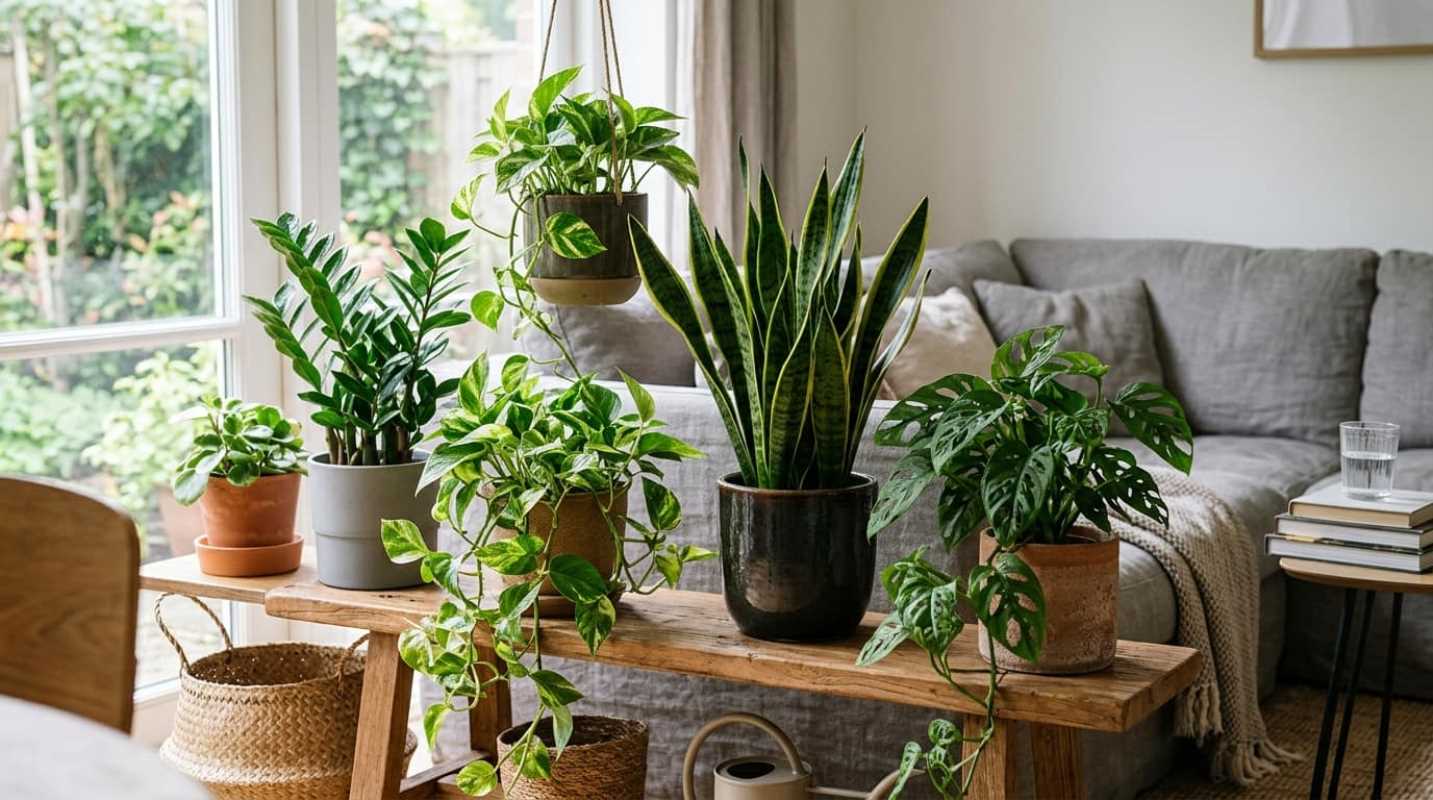
The three classic varieties that every new grower should start with are the Snake Plant, the ZZ Plant, and the Golden Pothos.
Snake plants (Dracaena trifasciata) are legendary survivors. They feature tall, stiff, sword-shaped leaves that store water like a camel. They can handle deep shade in an interior hallway or direct sun in a south-facing window. You can leave town for three weeks, forget to water, and return to find your snake plant looking completely unbothered.
ZZ plants (Zamioculcas zamiifolia) are equally tough. Beneath the potting soil, they produce thick underground tubers that look like small potatoes. These structures hold moisture reserves for dry spells. Their glossy, dark green leaves reflect light so well that visitors often ask if they're plastic. If you have a dim bedroom or a home office with only overhead lighting, a ZZ plant will do just fine.
Golden Pothos (Epipremnum aureum) gives you that classic trailing jungle look. What makes pothos great is how clearly it communicates. When it needs a drink, the leaves lose their stiffness and droop slightly. Give it a thorough soak, and the whole vine perks back up within a few hours.
• Snake Plant: Thrives on neglect and tolerates almost any lighting condition from dim corners to sunny windows.
• ZZ Plant: Features water-storing tubers that survive weeks without moisture and handles low light easily.
• Golden Pothos: An adaptable trailing vine that grows quickly and clearly signals when it wants water.
• Cast Iron Plant: Earned its name by surviving extreme temperature shifts and dark rooms without dropping foliage.
• Spider Plant: Produces cheerful arching leaves and baby plantlets while remaining completely non-toxic to pets.
Mastering the Basics of Light and Watering
You don't need a botany degree to keep these varieties alive. You only need to understand two basic things: light and moisture.
Think of light as plant food. Although fertilizer gives extra nutrients, light fuels daily growth. Low light means an interior room where you'd have trouble reading a printed book without turning on a lamp. Medium indirect light is bright, ambient daylight that casts soft shadows. Direct light means the sun's rays physically hit the leaves for hours at a time. The beginner varieties highlighted here do best in low to medium indirect light, where their leaves won't scorch.
For watering, the golden rule is simple. Underwatering stresses a plant, but overwatering kills it. Most dead houseplants didn't die of thirst. They drowned because soggy soil suffocated their roots and caused fungal rot.
Throw away any rigid calendar schedule like "water every Tuesday." Your home's temperature, pot size, and humidity change with the seasons, which alters how fast the soil dries out.
Use the finger test instead. Poke your index finger two inches into the dirt. If it feels cool and damp, leave the watering can alone. If it feels dry and dusty, give the pot a thorough drenching until water runs freely out of the drainage holes. Always discard the standing water in the drip tray so the roots don't sit in a puddle.
Styling Your Space with Resilient Greenery
Decorating with plants is just as fun as arranging art or furniture. Because these species are so adaptable, you aren't stuck crowding every pot onto a single windowsill.
Try setting a tall snake plant directly on the floor beside a media console to soften hard furniture lines. Place a pothos on a high bookshelf and let its trailing stems spill down over your book collection. A spider plant looks fantastic in a hanging planter near a window, where its arched leaves create movement in an otherwise static corner.
These hardy varieties also adapt well to the quirks of modern living spaces. They handle dry winter radiator heat and summer air conditioning without throwing tantrums.
What about indoor air? You've probably heard people say that houseplants clean the air in your house. The famous NASA experiments proved that plants absorb airborne toxins like benzene and formaldehyde. But those tests happened in sealed, airtight glass chambers. In an actual home with open doors and ventilation, you would need hundreds of plants to replicate mechanical air filters. Even so, plants improve local humidity and make any room feel fresh and alive.
Troubleshooting Common Beginner Pitfalls
Every plant owner faces a weird spot or a yellow leaf eventually. Don't panic when it happens.
A single yellow leaf near the bottom of your plant is usually normal. Leaves age, run their course, and drop off so the plant can direct energy toward fresh growth. Simply snip it off with clean scissors.
If multiple leaves turn pale yellow and feel mushy, that's your plant waving a red flag about too much water. Slide the plant out of its pot to inspect the root ball. Healthy roots are firm and light in color. Mushy, dark roots mean rot. Trim away the damaged sections, repot the plant in fresh potting mix amended with 20% to 30% perlite for better airflow, and let the soil dry out before watering again.
Do you notice dry, brown tips on your spider plant? That often happens because of chlorine and fluoride in municipal tap water. Switch to filtered water or rainwater for a couple of weeks, and the new growth will emerge clean and green.
Start Your Indoor Jungle Today
Bringing greenery into your living space doesn't have to be a high-stakes chore. You don't need a dedicated greenhouse, rare soil blends, or expensive grow lights to build a calm, green sanctuary.
Pick up a single snake plant or a small pothos vine on your next errand run. Find an attractive ceramic pot with a drainage hole, set it in a spot with gentle daylight, and check the soil once a week.
Caring for resilient greenery is a quiet, rewarding habit that grounds your daily routine. Start small, trust the process, and watch your indoor oasis take shape.
Sources:
1. Floral Marketing Fund
https://floralmarketingfund.org/houseplant-purchasing-trends-release/
2. International Journal of Environmental Research and Public Health
https://pmc.ncbi.nlm.nih.gov/articles/PMC9224521/
3. Texas A&M Today
https://stories.tamu.edu/news/2024/02/06/livening-up-your-space-with-plants-can-boost-your-mental-health/